Everything people ask before bringing hyperbaric oxygen therapy into a clinic, practice, or home — the science, the chambers, and what ownership looks like.
HBOT means breathing 93–98% pure oxygen inside a chamber pressurized above normal atmospheric pressure. Under pressure, far more oxygen dissolves directly into your blood plasma than breathing air ever could — saturating tissue throughout the body, not just what red blood cells can carry. Our science page walks through it interactively.
Pressure drives oxygen into the blood plasma, so it can reach tissue that red blood cells struggle to supply — inflamed, poorly-circulated, or hard-to-reach areas. That extra oxygen fuels the mitochondria to produce more cellular energy. Everything works from the inside out, at the cellular level, through what you breathe — nothing is absorbed through the skin.
ATA stands for Atmospheres Absolute. 1 ATA is sea-level pressure; each added atmosphere is roughly another 33 feet of seawater. Oxycell seated chambers run up to 2.0 ATA — the pressure the vast majority of clinical longevity and wellness research is done at.
Not for wellness and longevity. Pressures above 2.0 ATA are generally reserved for acute medical conditions under supervision, and risk rises steeply as pressure climbs. At 2.0 ATA you get the full benefit of the protocols the research is built on, with an excellent safety profile. Higher isn’t better — it’s just riskier.
Our chambers pressurize the cabin with air and you breathe pure oxygen through a mask or cannula. That delivers the same result as an oxygen-filled cabin — but without the flammability. The chambers that compress with pure oxygen (hospital units with oxygen tanks) are precisely the ones that have caught fire. Compressing with air and breathing oxygen through a mask is inherently far safer.
Air breaks cycle you between pure oxygen and normal air — typically 20 minutes on, 5 minutes off. That fluctuation triggers the hyperoxic-hypoxic paradox: even while oxygen-rich, the body reads the drop as a hormetic stress (like exercise) and responds by ramping up stem-cell production, new blood-vessel growth, and new mitochondria. Our OS/O₂™ software runs the cycles automatically at one touch — no phone timer, no taking the mask on and off.
Dr. Shai Efrati runs the Sagol Center for Hyperbaric Medicine and Research and has 30+ years of clinical trials behind him. His gold-standard protocol — 60 sessions in 90 days (five days on, two off) — is the one most longevity researchers and influencers follow. His book Beyond Normal is the best primer on the science. Our chambers automate his air-break protocol with OS/O₂.
It comes from Dr. Efrati’s published study of adults over 65, which reported an average 24% lengthening of telomeres after the protocol — a marker associated with cellular aging. We share the research rather than make claims; the research library links the sources.
HBOT has a long clinical history across wound healing, infection, and recovery, and is actively researched for cognition, recovery, performance, and longevity. We position our chambers as wellness devices and don’t make claims to diagnose, treat, or cure disease — we point you to the evidence. A good shortcut: search “NIH HBOT [topic]” on PubMed.
Each session runs 85–110 minutes, depending on the protocol. Dr. Efrati’s protocol is 60 sessions in 90 days for a full reset, then 1–3 maintenance sessions a week, repeating the full protocol roughly every two years. Owning a chamber is what makes that consistency practical.
You relax — seated or reclined — and breathe through a mask or nasal cannula while the chamber gently pressurizes. You’ll feel mild ear pressure during compression, like an airplane takeoff, eased by swallowing or yawning. Most people read, watch something, listen to music, work, or simply rest.
Mild HBOT at up to 2.0 ATA is widely regarded as very safe, and serious complications are rare. Our air-pressurized, breathe-through-a-mask design avoids the flammability of oxygen-filled hospital chambers. The chambers are also designed to be power-fail-safe — if power is lost, the cabin simply depressurizes slowly through a valve at your own pace.
Most are mild and temporary — ear discomfort, light fatigue, or lightheadedness — and equalizing during compression keeps sessions comfortable. More significant effects are uncommon and generally associated with higher-pressure clinical protocols above 2.0 ATA.
The one absolute contraindication is an untreated collapsed lung (pneumothorax). Use medical supervision if you have COPD, heart failure, or certain severe pulmonary conditions; take care with recent ear surgery, active upper-respiratory infections, uncontrolled hypertension, or certain chemotherapy. Evidence in pregnancy is limited. When in doubt, clear it with your physician first — our medical director is certified to evaluate and prescribe HBOT in all 50 states, and that evaluation is included with purchase.
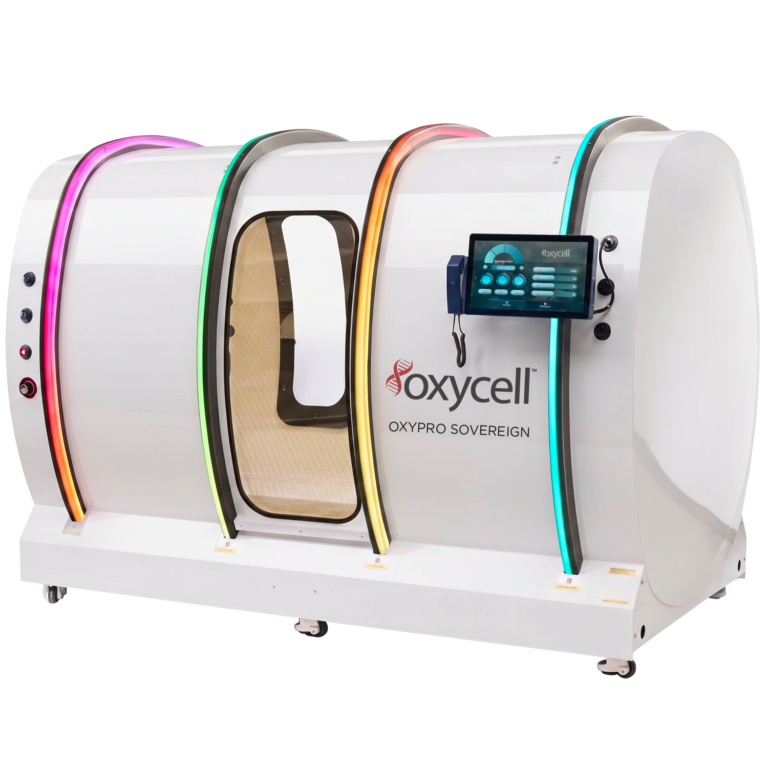
Yes — multiple people can share one chamber, each with their own inexpensive nasal cannula. Multi-place chambers (Genesis, Ultra, Sovereign) let two or three people run sessions together. Children use a lower pressure than the full 2.0 ATA. For pets, we also make purpose-built veterinary chambers in three sizes, since animals can’t wear masks.
No prescription is needed to purchase — chambers are sold as wellness devices. If you intend to address a specific medical condition, a licensed professional should clear you for HBOT first; our medical director can handle that evaluation as part of your purchase.
The OxyPro range spans single-person (monoplace) and multi-place hard chambers from the Excel to the flagship Sovereign — roughly $59,900 to $124,900 — plus the soft OxyMax line. The right pick comes down to who’s using it, your space, and whether it’s for a home, a clinic, or a wellness business. Browse the full collection, or tell our team your setting and goals and we’ll match one.
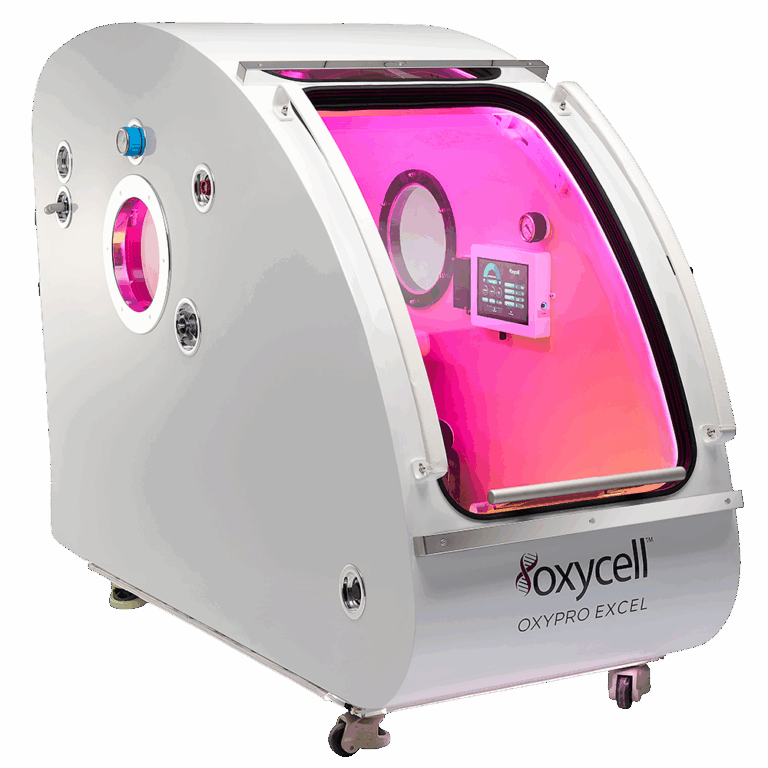
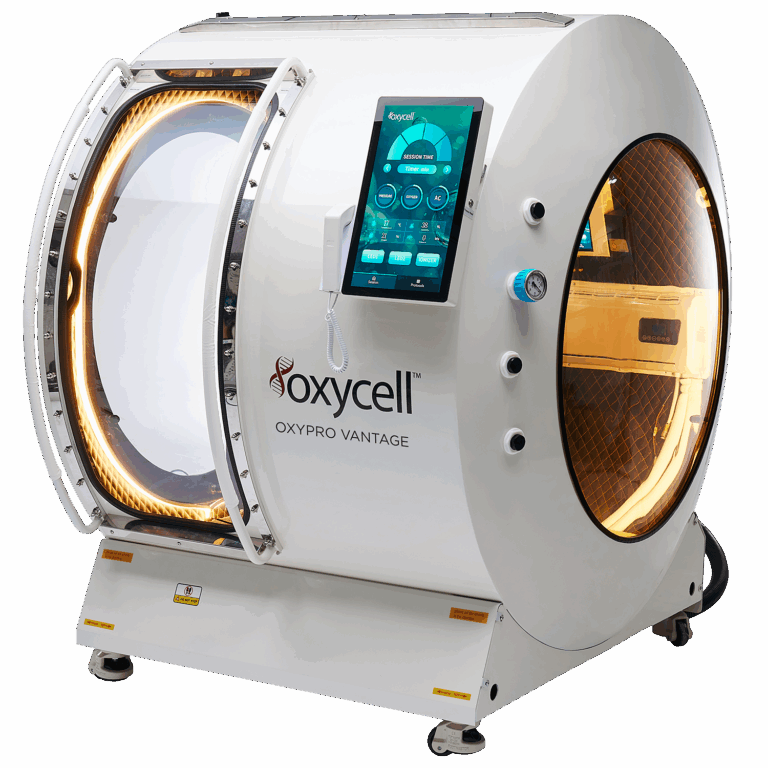
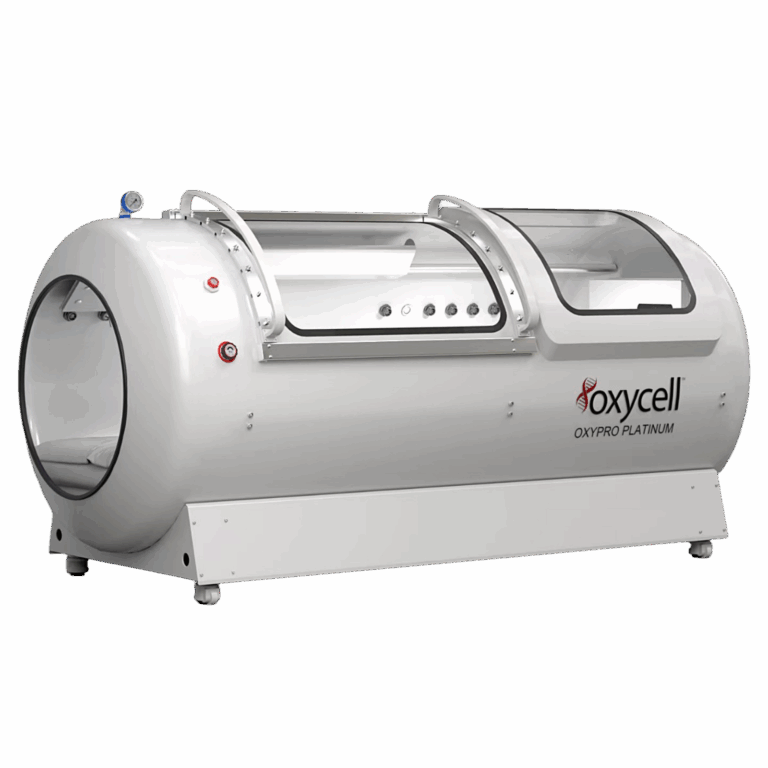
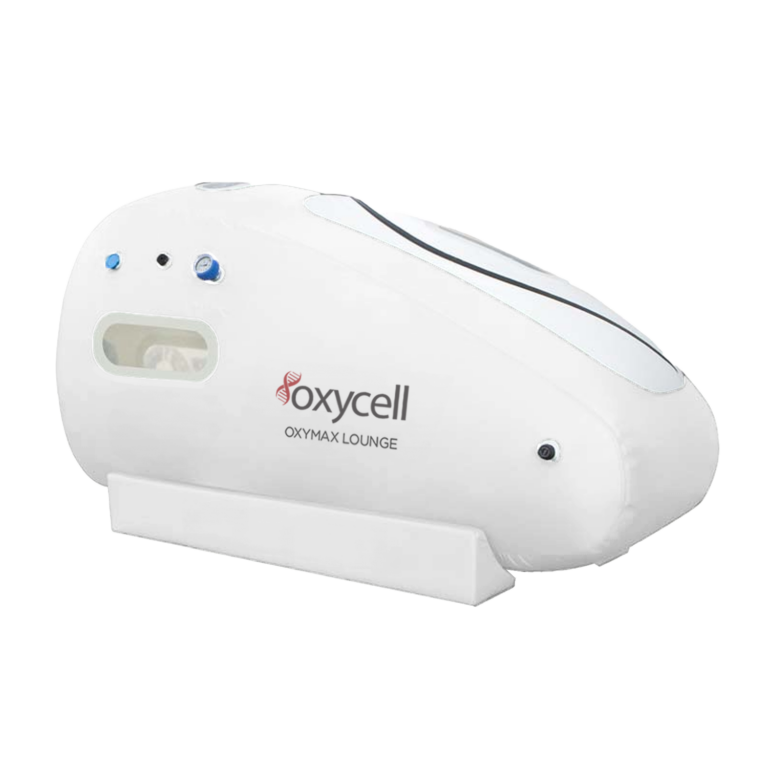
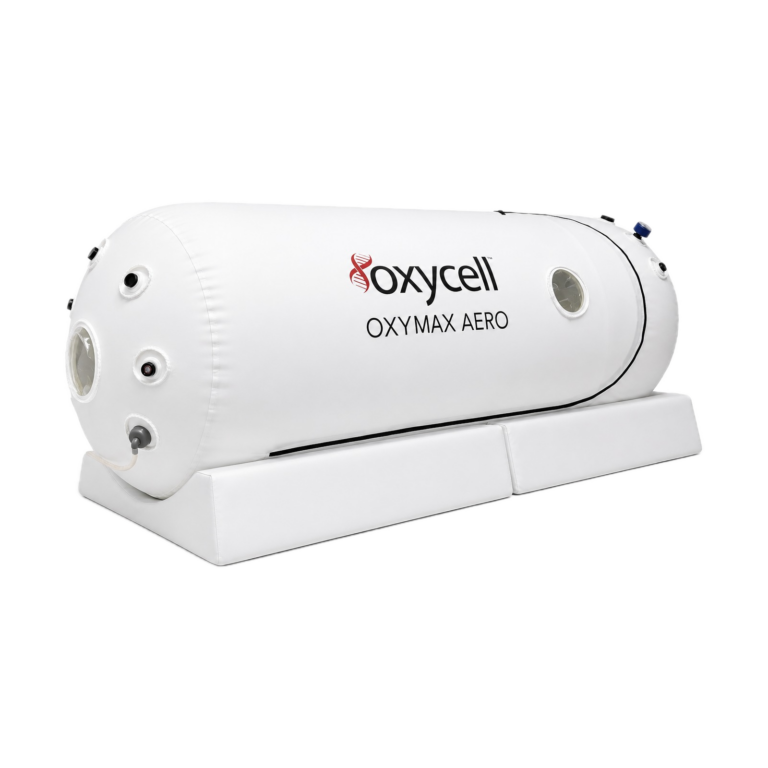
Mono-place chambers (Excel, Vantage, Platinum) are built for one person. Multi-place chambers (Genesis, Ultra, Sovereign) seat two or three. Soft chambers (OxyMax Aero, Lounge) are lighter, lower-pressure, and the most affordable entry point. All hard chambers run the same OS/O₂ protocols.
The OxyPro Excel is longer (about 79″ vs 59″) with more room to recline almost flat — best if you want to lie back and relax. The OxyPro Vantage is better as a workspace: room for a small TV, a larger red-light panel, or a desk to work inside. It really comes down to recline-and-relax versus sit-and-work.
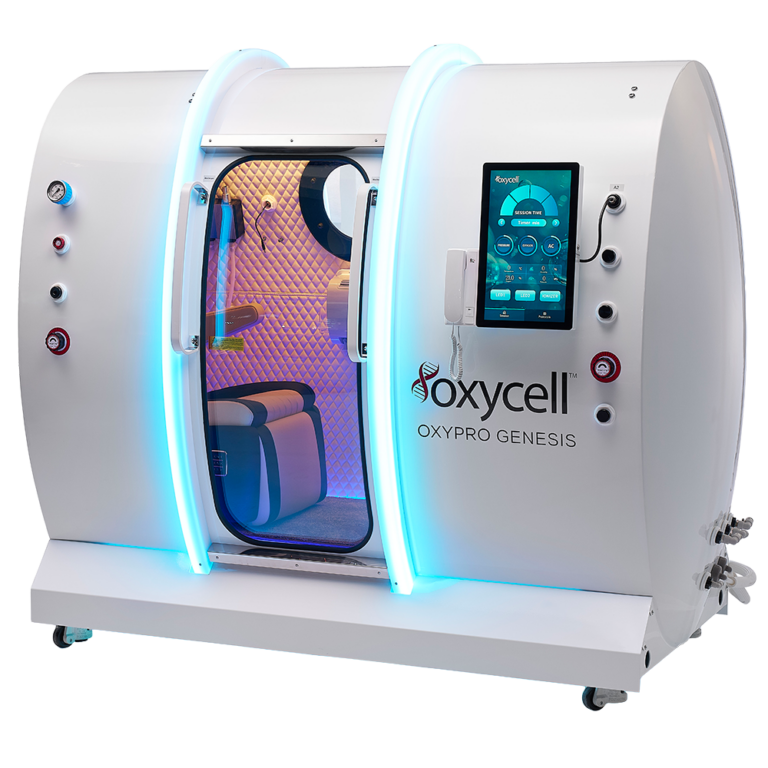
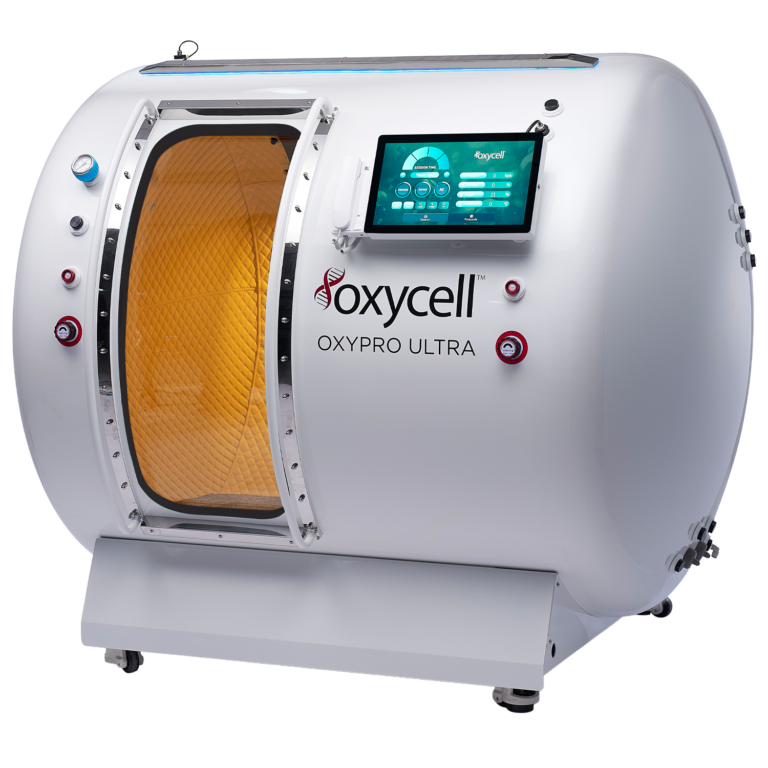
The OxyPro Genesis seats two in power-recliner chairs facing each other (great for a couple). The OxyPro Ultra is wider, seating two side-by-side with a TV in front. For three or a more spacious build, the Sovereign is the flagship and ships in sections for tight sites.
Hard chambers reach a true 2.0 ATA, where most of the research is done. Soft chambers top out around 1.3–1.5 ATA, so you’d need roughly double the session time to approach the same oxygen dose. Every Oxycell OxyPro is a hard-shell, ASME-built vessel; the OxyMax soft chambers are a lower-cost or stepping-stone option.
For most home users, no — it’s a clinical nicety, not a results upgrade. The BIBS (built-in breathing system) is a sealed, inhale-activated mask that vents your exhale outside the cabin, keeping it cleaner and adding a percent or two of oxygen — ideal for business use. The trade-off: it’s a tighter seal you have to breathe through consciously, and it needs extra power. The comfortable nasal cannula gets effectively the same outcome. If you do want it, it has to be pre-configured at order time.
The only FDA-approved chambers are soft altitude chambers (up to 1.3 ATA) or hospital-grade units that compress with oxygen tanks and cost $200K+ — the latter being the ones that have actually caught fire. The FDA approves devices for ~13 specific acute, life/limb conditions treated at high pressure under supervision; most owners aren’t treating those. We sell ours as wellness devices and lead on a higher manufacturing bar — ASME certification.
A chamber holds a person under pressure, so it should be built like a pressure vessel. Every Oxycell is manufactured to the ASME Boiler & Pressure Vessel Code — the standard used in aerospace and nuclear engineering — in the only ASME-certified HBOT factory in China, with 17 years of production and zero incidents. US-made alternatives (OxyHealth, Vitaris) are typically the same quality or less, at double or triple the price. The real differentiator is the OS/O₂ software, not just the shell.
At an ASME-certified factory in Shanghai — the only ASME-certified HBOT factory in China — which recently received the ASME U stamp for pressure vessels (now applied to new production). Final assembly is at our Torrance, California facility, and units ship from California or Florida. ASME is a far higher bar than ISO and takes 5–10 years to earn.
Yes — any RAL color at no extra charge (matte finishes are custom), leather interior options, power recliners on most models, and entertainment add-ons like a built-in TV (about $1,800–$2,400), Bluetooth audio, and USB charging. The BIBS mask system is a $4,000–$5,000 upgrade that must be specified up front.
Plan for roughly an 8′ × 10′ footprint for a single-person chamber, with room to enter comfortably and for airflow. Our team reviews your space during the buying process so there are no surprises on delivery day.
The Excel is about 34″ wide and clears a standard 36″ door (mind the moldings on new construction). Wider units like the Genesis may need a garage entry or a crane. For tight access we build sectional models — the Vantage S arrives in two pieces (27.5″ and 31.5″ long) and the Sovereign in three, assembled on site. Send us a quick video of your entry route and our logistics team will map it before you ever order.
Everything runs on standard 110V — no 240V required. Every chamber needs dedicated 20A circuits, “dedicated” meaning nothing else draws on them. The count depends on the model: OxyPro Excel and OxyPro Platinum need 2; OxyPro Vantage, Vantage S, Vantage XLS, OxyPro Ultra and OxyPro Genesis need 3; OxyPro Sovereign needs 4. The count is the same whether or not you add BIBS — a multi-seat BIBS Sovereign needs additional circuits, which we confirm for your exact configuration. Several power cords share one circuit, so the number of cords is not the number of circuits. If you’re building or renovating, have your electrician run dedicated circuits to the room, and our team confirms your setup before delivery.
Every chamber ships white-glove: a crew of up to six brings it inside, sets it up, and connects everything (cabins weigh from 573 lbs up to 2,540 lbs). A technician then does an operations walkthrough and verifies everything is working. We routinely handle cranes, garage installs, and tight urban access — one Park Avenue delivery needed a crane, permits, and a road closure, and we plan ahead specifically to avoid surprises like that.
It depends on the model and current stock. Soft chambers are about 1–2 weeks; the Platinum is often in stock (1–2 weeks); the Excel runs about 2–4 weeks; the Vantage, Genesis, and Ultra are roughly 8–9 weeks (sometimes faster if pre-built units are available); the Sovereign is on a custom timeline. In-stock units ship much sooner.
Yes — we ship to Hawaii regularly and have installation crews on the islands. There’s an added freight cost to reach remote locations, but white-glove delivery and on-site setup are still included.
Very little. Change the air filter every 1,000 hours — about once a year for home use, ~6 months for a busy clinic — at roughly $40–$50 a filter (spares are included). Rubber seals get replaced after several years, like tires on a car. No consumables, no recurring software fees. An optional maintenance program ($1,200/yr) adds an annual inspection and service and can extend the warranty.
Nothing harmful. The chambers are designed to be power-fail-safe — the cabin depressurizes slowly through a release valve that you open at your own pace. There’s no sudden change and nothing to manage in an outage.
OxyPro hard chambers range from $59,900 to $124,900 depending on model and configuration, with the soft OxyMax line as a lower-cost entry point. Talk to sales for a configured quote — packages bundle in upgrades like red-light therapy, power recliners, and entertainment.
Yes. For consumers, Affirm covers up to $30,000 (interest-free up to 24 months with qualified credit), with the remainder by ACH, wire, or card. For businesses we work with dedicated lenders and a rental partner. Payment methods include wire, ACH through QuickBooks (no fee), or card (3% transaction fee). For longer-lead units it’s typically 50% to start and the balance before delivery. Ask sales for the options that fit you.
Many business buyers use Section 179 / bonus depreciation to write off equipment like this — it’s a common reason orders cluster in Q4. We’re not accountants and can’t give tax advice, so confirm the specifics with yours.
Typically: the chamber, a pre-installed red-light therapy panel, OS/O₂ software with Dr. Efrati’s protocols, white-glove delivery and installation, a technician walkthrough, a doctor-led training course, masks and cannulas, spare air filters, informed-consent documentation, and the 2-year warranty. No customs fees, no hidden charges, and no sales tax outside Florida.
A full two-year warranty covering the entire chamber — parts and labor. The only thing not covered is the air filter, which is normal maintenance at about $40–$50. The optional 3-year maintenance program extends coverage to four years.
No. The built-in oxygen concentrator makes all the oxygen the chamber needs — there are no oxygen tanks and no consumables. The only ongoing cost is electricity (roughly 2,600–6,700 watts in standard configuration, on standard 110V household power) plus the inexpensive air filter once a year or so.
Two options come included: a Home User course (about 3–4 hours) covering operation, safety, and protocols; and a Practitioner Certification (about 6–8 hours) that adds consent forms, business protocols, and an IHA/IBUM hyperbaric-technician certification. After installation, a technician also does a live video walkthrough.
Yes — many of our customers are clinics, practices, and wellness centers. At minimum you’ll want a medical director and trained, certified staff; our Practitioner Certification covers the technician credential, and our medical director can advise on safe, compliant operation. We also provide consent forms and business documentation, and offer dealer and affiliate arrangements.
The best first step is a short conversation. Contact our sales team and we’ll match a chamber to your space, goals, and budget, review your delivery access, and prepare a personalized proposal — financing included.
No questions match “”. Try another term, or ask our team.
These statements have not been evaluated by the FDA. This information is for education only and is not a substitute for professional medical advice. Consult your physician before beginning any new therapy.
Our team answers chamber, protocol and financing questions every day. Get a personalized recommendation for your space and goals.